59 policies. 10 categories. Context anchoring. Auto-skills. Claude builds your project with governance baked in from line one.
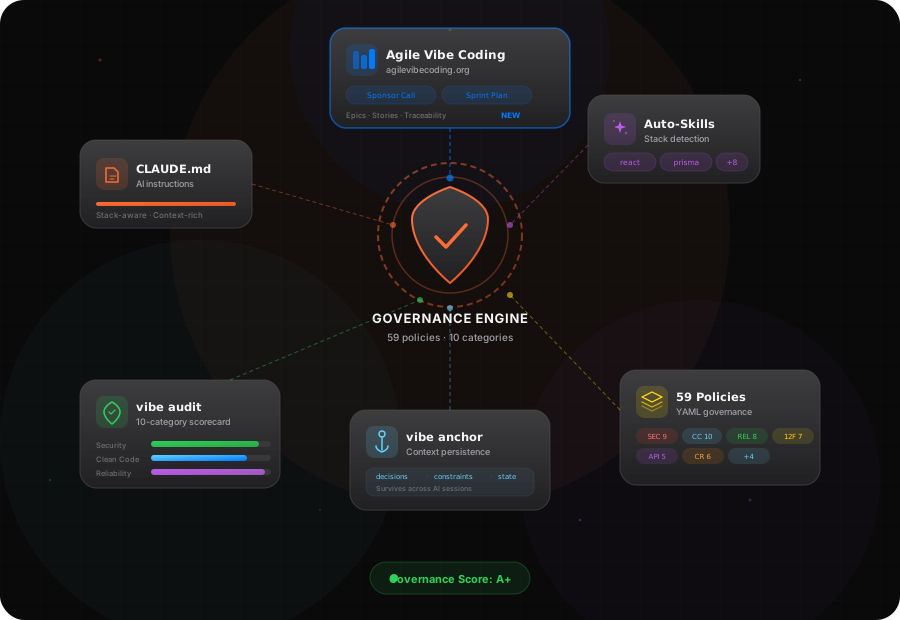
Not a template generator. A project intelligence engine that works on any codebase.
Describe your idea in plain English. Claude generates personas, features, architecture decisions, and a complete production-ready codebase.
vibe scan analyzes any existing project — detects stack, framework, missing best practices, and auto-generates a CLAUDE.md. No API key needed.
vibe add docker, vibe add ci, vibe add testing — inject production features into any project. Idempotent and stack-aware.
vibe doctor scores your project with 17 weighted checks across 7 categories. Get a letter grade (A+ through F) with fix suggestions.
vibe run spawns Claude Code with your CLAUDE.md as context. Claude understands your architecture before writing a single line.
vibe ask lets you consult Claude about architecture, security, or performance — without making any file changes.
Prepare, build, anchor, audit — repeat.
Generate 59 governance policies, CLAUDE.md instructions, auto-detected skills, and ADR templates. The foundation for governed AI coding.
Describe your idea. Claude enriches it into personas, features, and architecture — then builds the project following all governance policies.
Capture decisions in persistent context documents. Decisions table, constraints, open questions — survive across chat sessions.
10-category governance scorecard: security, accessibility, reliability, performance, compliance, clean code, API, data, code review, observability.
Built on the Agile Vibe Coding Manifesto — traceable intent, human accountability, and structured ceremonies for AI-assisted development.
Structure AI work into epics, user stories, and tasks. Every generated line of code traces back to a requirement — not a vibes-only prompt.
Sponsor Call and Sprint Planning ceremonies adapted for AI. Context transfer becomes structured, repeatable, and auditable.
New governance category: every feature links to a decision record, every story links to an epic, and every change links to a story.
Manifesto Principle III — Traceable Intent: Every feature and generated code must link back to a requirement or decision. Without traceability, you can't audit, you can't maintain, and you can't scale.
vibe graphify wraps ai-graphify — a knowledge graph engine that spans code, docs, papers, images, audio, and video. Where CodeGraph indexes symbols, Graphify indexes everything — and emits a one-page audit, an interactive HTML graph, and a queryable JSON file your team commits to git.
Deterministic AST pass for code. Local Whisper transcription for audio/video. Claude subagents for docs, papers, images, and transcripts. Three passes, one merged graph.
Every relationship is tagged EXTRACTED, INFERRED, or AMBIGUOUS. You always know what was found vs. guessed — no silent hallucination.
Leiden community detection on extracted relationships — no embeddings, no vector DB. The graph structure is the similarity signal.
Use Graphify for orientation and cross-modal questions. Use CodeGraph for callers, callees, and impact. Both can coexist — they are complementary.
Auto-wired by vibe init: CLAUDE.md gets a marker-fenced ## Graphify section, .claude/commands/graphify.md teaches Claude when to query the graph, and .gitignore excludes the regenerable cache while keeping graph.json and GRAPH_REPORT.md committable for the team.
Not starting from scratch? Vibe Init analyzes, scores, and upgrades any codebase.
Prepare, build, anchor, audit, analyze, enhance, code, advise — and now graph your project across code, docs, papers, audio, and video.
docker, ci, testing, logging, validation, health, hooks, auth, db. Claude-powered: api, component, model.
vibe doctor. Governance compliance audit with 59 policies, 10 categories, and severity levels (block/warn/info).
@colbymchenry/codegraph. Builds a local SQLite knowledge graph of your code so Claude's Explore agent can answer "how does X work?" with one MCP call instead of dozens of grep/read calls.
graphifyy (PyPI). Builds a multi-modal knowledge graph spanning code, docs, papers, images, audio, and video. Outputs interactive HTML, queryable JSON, and a plain-language audit. Auto-installs via uv, pipx, or pip.
The framework adapts to your stack. CLAUDE.md, skills, and conventions are tailored to your technology choices.
App Router
Strict mode
ORM + Migrations
Primary database
Cache layer
Multi-stage builds
CI/CD pipeline
Fast testing
Structured logging
Validation
Git hooks
Conventional commits
Visual overview of modules, data flow, and governance lifecycle.
graph TB
subgraph CLI["CLI Layer — src/index.ts"]
direction LR
init["vibe init"]
build["vibe build"]
scan["vibe scan"]
add["vibe add"]
audit["vibe audit"]
anchor["vibe anchor"]
run["vibe run"]
ask["vibe ask"]
end
subgraph CORE["Core Engine"]
direction TB
framework["Framework Generator
CLAUDE.md + Skills + Settings"]
enrichment["Enrichment Engine
Personas · Features · Arch"]
governance["Governance Registry
59 Policies · 10 Categories"]
analyzer["Stack Analyzer
4 Stack + 10 Practice Detectors"]
features["Feature Registry
12 Pluggable Modules"]
scoring["Health Scoring
17 Weighted Checks"]
contexts["Context Anchoring
Persistent Decision Docs"]
end
subgraph AI["AI Integration"]
direction LR
claude_cli["Claude CLI
Interactive · Streaming"]
anthropic["Anthropic SDK
Batch · Structured"]
end
subgraph OUTPUT["Generated Artifacts"]
direction LR
claudemd["CLAUDE.md"]
policies["59 YAML Policies"]
skills[".claude/commands/"]
adrs["docs/adr/"]
ctxdocs["docs/context/"]
end
init --> framework
init --> governance
build --> enrichment
scan --> analyzer
add --> features
audit --> scoring
audit --> governance
anchor --> contexts
run --> claude_cli
ask --> claude_cli
enrichment --> claude_cli
framework --> anthropic
scoring --> analyzer
framework --> claudemd
framework --> skills
governance --> policies
enrichment --> adrs
contexts --> ctxdocs
sequenceDiagram
participant Dev as 👤 Developer
participant CLI as ⚡ vibe CLI
participant Gov as 🛡️ Governance Engine
participant AI as 🤖 Claude
participant FS as 📁 Filesystem
rect rgb(30, 30, 33)
Note over Dev,FS: Phase 1 — Initialize Governance Framework
Dev->>CLI: vibe init
CLI->>Gov: Generate 59 YAML policies
Gov-->>FS: .vibe/policies/*.yaml
CLI->>AI: Generate CLAUDE.md (stack-aware)
AI-->>FS: CLAUDE.md
CLI->>FS: .claude/commands/ (auto-skills)
CLI->>FS: .claude/settings.json
CLI->>FS: docs/adr/000-template.md
CLI-->>Dev: ✅ Framework ready
end
rect rgb(30, 30, 33)
Note over Dev,FS: Phase 2 — Build with Governance
Dev->>CLI: vibe build
CLI->>Dev: Describe your idea
Dev-->>CLI: "A pet health tracker..."
CLI->>AI: Enrich idea → Personas, Features, Architecture
AI-->>CLI: EnrichmentBrief
CLI->>Dev: Review enrichment
Dev-->>CLI: Approve ✅
CLI->>AI: Build project (CLAUDE.md + Brief + ADR as context)
AI-->>FS: Complete project with governance
CLI-->>Dev: ✅ Project built
end
rect rgb(30, 30, 33)
Note over Dev,FS: Phase 3 — Anchor & Audit
Dev->>CLI: vibe anchor "auth"
CLI-->>FS: docs/context/auth.md (decisions, constraints, state)
Dev->>CLI: vibe audit
CLI->>Gov: Check 59 policies against project
Gov-->>CLI: 10-category scorecard
CLI-->>Dev: Grade: A+ to F + fix suggestions
end
flowchart LR
subgraph INPUT["Input"]
idea["💡 Idea"]
project["📂 Existing Project"]
feature["🔧 Feature Name"]
end
subgraph DETECT["Detection"]
stack["Stack Detection
Next.js · FastAPI · Go · Node"]
practice["Practice Detection
Docker · CI · Tests · Lint
Env · Logging · Health
Hooks · Security · Docs"]
end
subgraph PROCESS["Processing"]
enrich["Claude Enrichment
→ Personas
→ P0/P1/P2 Features
→ Architecture"]
generate["Policy Generation
→ 59 YAML files
→ 10 categories
→ 3 severity levels"]
score["Health Scoring
→ 17 weighted checks
→ 7 categories
→ A+ through F"]
end
subgraph OUTPUT["Output"]
claudemd["CLAUDE.md
AI Instructions"]
yaml["YAML Policies
Security · Clean Code
Reliability · 12-Factor
API · Performance
Data · Code Review
Observability · A11y"]
codebase["Built Codebase
Governed by CLAUDE.md"]
report["Audit Report
Scorecard + Fix Commands"]
end
idea --> enrich
project --> stack
project --> practice
feature --> generate
stack --> enrich
practice --> score
enrich --> codebase
generate --> yaml
score --> report
enrich --> claudemd
graph TB
GOV["🛡️ Governance Engine
59 Policies · 10 Categories"]
subgraph SEC["Security — 9 policies"]
s1["sec-001 .gitignore"]
s2["sec-002 No secrets"]
s3["sec-003 Env validation"]
s4["sec-004 Input validation"]
s5["sec-005 ORM usage"]
end
subgraph CC["Clean Code — 10 policies"]
c1["cc-001 TS strict"]
c2["cc-002 No any"]
c3["cc-003 Linter"]
c4["cc-004 Formatter"]
c5["cc-005 Git hooks"]
end
subgraph REL["Reliability — 8 policies"]
r1["rel-001 Health endpoint"]
r2["rel-002 CI/CD"]
r3["rel-003 Tests"]
r4["rel-004 Graceful shutdown"]
end
subgraph API["API Governance — 5 policies"]
a1["api-001 OpenAPI spec"]
a2["api-002 Versioning"]
a3["api-003 Rate limiting"]
end
subgraph TF["12-Factor — 7 policies"]
t1["12f-001 VCS"]
t2["12f-002 Deps"]
t3["12f-003 Config in env"]
end
subgraph OTHER["+ 5 More Categories"]
o1["Code Review — 6"]
o2["Performance — 4"]
o3["Data Governance — 4"]
o4["Observability — 4"]
o5["Accessibility — 2"]
end
GOV --> SEC
GOV --> CC
GOV --> REL
GOV --> API
GOV --> TF
GOV --> OTHER
Your next project is one command away.